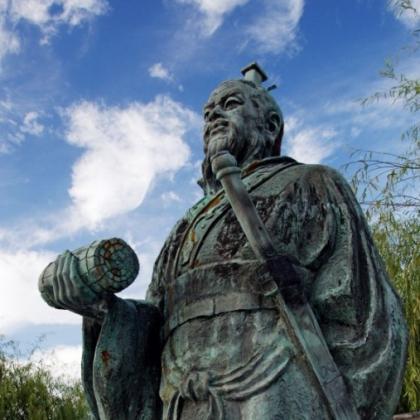
Since a while, the United States of America has a Department of War which seems to be taking its task quite seriously with military expenditures rising to an unprecedented 1.5 Trillion per year, equalling 1/3rd of global military spending. Meanwhile, the European Union is militarizing its industry and pouring millions upon millions into the corrupt bottomless pit called Ukraine. The decrepit U.K. is planning to drastically increase its “defense” budget. The State of Israel’s “Defense” Force has turned Gaza into an inhabitable wasteland and keeps on doing its best in Lebanon. While suffering from intensified drone attacks, Russia is steadily securing its grip on the Donbas. Iran responds to the threat of being bombed “back to the stone age” by attacking American bases all over the Middle East. Amidst all this brutal turmoil, China excells in stealthily expanding its “soft powers”. Apparently, they’re the only ones who have not shelved The Art of War, the military treatise attributed to China’s most famous military strategist and general: Sun Tzu.
Conquer without fighting
In Sun Tzu’s Stratagem the first and foremost rule in warfare provides that “the best thing of all is to take the enemy’s country whole and intact; to shatter and destroy it is not so good. […] Therefore the skillful leader subdues the enemy’s troops without any fighting; he captures their cities without laying siege to them; he overthrows their kingdom without lengthy operations in the field. […] Hence to fight and conquer in all your battles is not supreme excellence; supreme excellence consists in breaking the enemy’s resistance without fighting.”
The essentials for victory
According to Sun Tzu, there are five essentials for victory: “(1) He will win who knows when to fight and when not to fight. (2) He will win who knows how to handle both superior and inferior forces. (3) He will win whose army is animated by the same spirit throughout all its ranks. (4) He will win who, prepared himself, waits to take the enemy unprepared. (5) He will win who has military capacity and is not interfered with by the sovereign.”
Know the enemy and yourself
Sun Tzu saved the most important rule for last. At the end of his Stratagem, he said: “If you know the enemy and know yourself, you need not fear the result of a hundred battles. If you know yourself but not the enemy, for every victory gained you will also suffer a defeat. If you know neither the enemy nor yourself, you will succumb in every battle.” This rule has nothing to do with gathering intelligence and information about your and your enemy’s military capacities, weaponry, fortifications, organization, etc. This rule concerns knowing your and your enemy’s SELVES.
The “reflective distance”
When it comes to knowing yourself we easily spiral downwards into a Gordian Knot when we remain unaware of what the political philosopher Eric Voegelin described as “reflective distance”, which he defined as “the realization of the difference between the experience of existence as an event of conscious ‘participation’ in being and the expression of this event in language symbols.” Voegelin considered this realization “an essential ingredient, […], in the ‘balance of consciousness’”, since it “involves the conception of truth not as information, but as growth of luminosity in the process of reality.” He thus created a clear and categorical distinction between participating in being and the expression of this event in terms of knowledge that consists of information formed by language symbols. The crux of the matter is that you can’t know your self by studying the “reflective” language symbols that you’ve used to express your conscious participation in being. It is that participation which precedes the language symbols and it is only in that participation that you may know “Thyself” as a participating being, provided of course that the participation is conscious.
Truth and mystical consciousness
The concept of “reflective distance” permits us to understand how truth transcends correctly obtained information in the sense that the realization of truth now takes place in the “knower” as a growth in luminosity in a reality in which he/she partakes as a participant at the Ground of Being. Truth thus becomes an experiential realization that transcends the establishment of the correctness of facts, data or opinions. When the cognitive effort is thus gracefully converted into an existential experience, knowledge and the study of knowledge are converted into mystical consciousness. It is in this consciousness that we find truth as the certainty of being a spiritual being at the Divine Ground of Being. This existential experience cannot be provoked, invoked, understood or grasped by the human intellect, for which it remains out of reach. Divine consciousness escapes the effort of knowing, because the conscious experience of a state of being doesn’t involve a cognitive effort made prior to, during or following the experience. In fact, such an effort will effectively prohibit and distort the conscious experience. To know our selves, we need to unknow what we know about ourselves. We must follow the via negativa.
The via negativa
In Orthodox Dogmatic Theology, protopresbyter Michael Pomazansky (1888 – 1988) pointed the via negativa to the Divine Ground of Being by quoting the 4th century St. Basil the Great, who was Archbishop of Casesarea. “If you wish to speak or hear about God”, St. Basil theologized, “renounce your own body, renounce your bodily senses, abandon the earth, abandon the sea, make the air to be beneath you; pass over the seasons of the year, their orderly arrangement, the adornments of the earth; stand above the ether, traverse the stars, […]. Having passed through all of this in your mind, go about heaven and, standing above it, with your thought alone, observe the beauties which are there […]. Having gone past all this and left below the whole of creation in your thoughts, raising your mind beyond the boundaries of it, present to your mind the Essence of God, unmoving, unchanging, unalterable, dispassionate, simple, incomplex, indivisible, unapproachable light, unutterable power, infinite magnitude, resplendent glory, most desired goodness, immeasurable beauty that powerfully strikes the wounded soul, but cannot worthily be depicted in words.” Such exaltation of spirit, so Pomazansky, “is demanded in order for one to speak of God! But even under this condition the thoughts of man are capable only of dwelling in the attributes of the Divinity, not upon the very Essence of the Divinity.”
The Tao
In Eastern religious philosophy, the via negativa is called Tao or Dao. It is simultaneously the Logos of the entire universe and the path that leads to it. It is Absolute Truth and the Ultimate Reality behind all phenomena. The Tao was first described by the Chinese philosopher Lao Tzu in his Tao Te Ching as:
….. something undifferentiated and yet complete.
Which existed before heaven and earth.
Soundless and formless.
It depends on nothing and does not change.
It operates everywhere and is free from danger.
It may be considered the Mother of the universe.
I do not know its name; I call it Tao.
…..
We look at it, and we do not see it, and we name it ‘the Equable’.
We listen to it, and we do not hear it, and we name it ‘the Inaudible’.
We try to grasp it, and do not get hold of it, and we name it ‘the Subtle’.
With these three qualities, it cannot be made the subject of description;
and hence we blend them together and obtain ‘The One’.
Victory and defeat
A general who seeks to be victorious in war must possess more than just military skills. Before going to battle, he must look at the Invisible, listen to the Inaudible and grasp the Subtle, to then blend these qualities of the Tao together and obtain The One. He must be able to present to his mind the Essence of God. He must be aware of the “reflective distance” that marks the difference between the experience of his conscious participation in the Divine Ground of Being and the expression of this event in the “precipitate” formed by words and thoughts. That’s how he can set the stage for unknowing all that he knows about himself and experience his True Spiritual Self in the Tao. In the words of Sun Tzu: “Those skilled in war cultivate the Tao and preserve the laws and are therefore able to formulate victorious policies.” To be sure, it is from his “vantage point” in the Tao that the general must, in the balance of his consciousness, rigidly apply all of Sun Tzu’s military rules and instructions. But generals who dodge or disregard fulfilling Sun Tzu’s most essential prerequisite to be successful in war, who shove it aside as “silly” and are confident that they can go to war without devoting themselves to the deepest form of self-reflection, will eventually bite the dust. “What can they expect if not defeat?”, wrote master Li Ch’üan, in his annotations on Sun Tzu’s The Art of War . “Such people are called ‘mad dogs’.” Nowadays, such people are called “war hawks”. They’re mad masters in the Art of Endless War.
+ + + + + + + + +