More than ever before, the powers that be are showing their cards when it comes to controlling and bullying you by vastly expanding their ways and abilities to “ID” you. Digitalizing your ID is the latest development in satisfying this irrepressible lust for power. True to form, the unelected European legislature, the EU Commission, is playing its part. Its faceless and invisible bureacracy has designed and begun promoting a “Personal Digital Wallet” that Member States must make available to their citizens. This Wallet goes way beyond what is normally required to identify yourself: name; date and location of birth. EU Digital Identity Wallets will contain all “your personal data” that “tell your life’s story“. The wallets, so says the EU, “will enable you to safely request, store and share important digital documents about yourself and electronically sign or seal documents”. [i] [ii]
Enhancing your privacy … ?
Your Digital Wallet will open the door to a digital Nirvana. “Obtaining a new bank account, enroll in a university abroad, or applying for your next dream job will be as easy as it is secure. And your privacy will always be respected; you control what data is shared and who gets to use it.” This utter nonsense obfuscates the fact that whoever “gets to use it” ‒ providers of private and public services demanding digital identification ‒ determines how it will use the “shared data” and how your private data will be protected against hackers and against being shared with other “users” without your knowledge. Once you’ve shared your personal data, they’re beyond your control. Still, the European Union glibly asserts that “with more and more private and public services becoming digital, a safe, reliable, and privacy enhancing means of digital identification is needed for everyone in Europe.” Just in case you didn’t get it, the more you share the content of your Wallet with ID-hungry outsiders, the more you’ll enhance your privacy …
Proving who we are
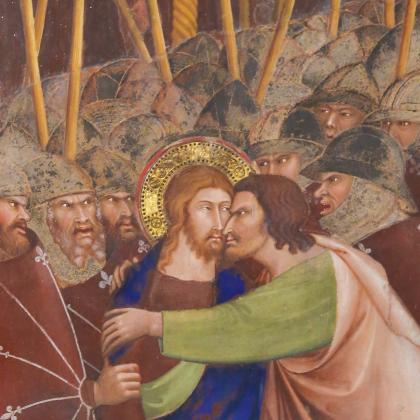
When you open EU’s Wallet, you’ll discover a special commemarative coin on which it printed the following slogan: “Identification is how we prove who we are; …” The point is, however, that your ID doesn’t provide proof of who you really are. Nowhere else was this explained better than in the Gospel of St. John. In the verses 18:4‒9, the Apostle describes what took place when Judas, having received a band of men and officers from the chief priests and Pharisees, came thither with lanterns and torches and weapons to apprehend Jesus. When they had found Jesus, Christ “went forth” and asked them “Whom seek ye?”. According to the King James Bible, “they answered him: Jesus of Nazareth.” Whereupon “Jesus saith unto them, I am he.” But instead of apprehending Jesus right away, “as soon then as he had said unto them, I am he, they went backward, and fell to the ground. Then asked he them again, Whom seek ye? And they said, Jesus of Nazareth.” Whereupon Jesus said: “I told you that I am he: if therefore ye seek me, let these go their way.”
“Ego eimi” means “I I-am”
It’s quite obvious that what really took place here cannot be properly understood from reading the King James translation, in which Jesus answers with the words “I am he”. Neither can it be found in other translations that follow the similar Latin (Vulgata) version of the original Greek texts. Why on earth would a band of rough-shod Roman soldiers and imperious officers of the high priests and Pharisees, who carried lanterns, torches and weapons, go backward and fall to the ground when the unarmed Jesus peacefully made himself known as “he”? St. John’s words make sense only when we literally translate what Jesus really said ‒ “Ego eimi” ‒ as “I I-am”, not as “I am he”. Greek verbs don’t require personal pronouns in their conjugation. The English pronoun that is implied in “eimi” is not “he” but “I”. “Eimi” means “I am”. It doesn’t mean “he is” or “I am he”. Jesus said no more than “I I-am”. It is in these few words, that John describes how Christ manifested Himself through Jesus of Nazareth by showing His true – transcendental / divine – nature. “My name is ‘I am’.”
A higher level of being
The Gospel is not a historic positivist account of worldly affairs and events. It is an account that reflects a message spoken to us from a higher level of being, from the level of Christ, the Son of God. And so, the words spoken by Jesus become meaningful only when we accept that they express what He ‒ Christ ‒ had to “say” from that higher level of being so that, through Jesus, they could be heard at the lower level and be relayed as coming from that higher level by the authors of the Gospels. The Gospels serve no other purpose than showing us that a higher level of being, which is the level of Christ, exists in and is attainable by Man. Christ “spoke” from this level while he was fully embodied in the man called Jesus of Nazareth. After the crucifixion of Jesus, Christ remained as the living Spiritual Being that was not affected by the death of Jesus.
The Ground
Speaking the words “Ego eimi“, it was not Jesus of Nazareth who made himself known. It was the Son of God, communicating from a higher level of being, Who made Himself known. Had Jesus answered “I am he”, the effect would have been entirely different. The soldiers and officers would have simply proceeded and said, “So, you’re Jesus of Nazareth, fine, then come with us. We’ll bring you to trial.” Instead, they withdrew backwards and fell to the ground. In this case, ground, “chamai” (“χαμαί”), represents the lowest level of being. The Greek word has as its root the word “chasma” (“χάσμα”), which means chasm, abyss or fissure in the earth. By going backwards, the rabble fell to the ground into a gaping abyss.
The Son of God
Given the situation, it is impossible that they physically fell to the ground and prostrated in front of Jesus to show Him their deepest respect and adoration. No. They didn’t seek Christ, they sought Jesus of Nazareth. They operated at the “ground”, the lowest level of being that stands in contrast to the Kingdom of Heaven, the highest level of being, from which Christ, the Son of God, had emanated. Jesus’ captors experienced the abyss where, spiritually speaking, they had fallen into, when unexpectedly they were exposed to the power that the Son of God showed by making His appearance and revealing to them His true identity. It is telling that Judas, who was “standing there with them”, also fell into this spiritual abyss as betrayer of the Christ Whom he knew. Without the slightest form of force, two words were enough to throw his inquisitors into a spritual abyss: “Ego eimi.” When, from the abyss, the question was raised for a second time, Christ confirmed the difference in levels of being by saying: “I told you, Ego eimi”, which is the name that the Son and the Father have in common: “I am I-am”.
Just say … “I am”
So, the next time you must “ID” yourself, just remember that you are not “your personal data” that “tell your life’s story”. You are an individual, a spiritual being, whose name is “I am”. You’re not the name printed in your passport. Neither were you born on the date and at the place mentioned in your passport. You’re not ‘data in the form of numerical digits’. You’re God’s immortal creature. As such, you’re nothing but beingness. You are “I am”. If you don’t believe me, just say “I am” – full stop – and you’ll feel what I mean. Only then will the powers that are in search of your ID “go backward and fall to the ground”. They’ll find out that they have no power over who you really are at the Divine Ground of Beingness.
+ + + + + + + + +
[i] https://ec.europa.eu/digital-building-blocks/sites/spaces/EUDIGITALIDENTITYWALLET/pages/694487738/EU+Digital+Identity+Wallet+Home
[ii] https://ec.europa.eu/digital-building-blocks/sites/spaces/EUDIGITALIDENTITYWALLET/pages/791609471/What+is+the+Wallet