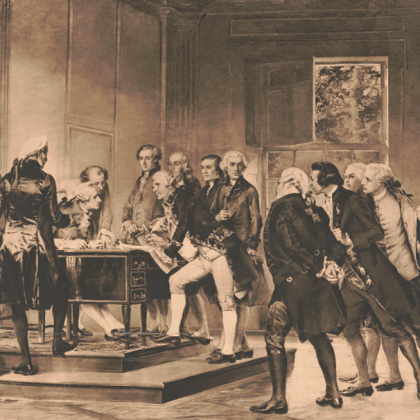
This Happy New Year marks the 250th anniversary of The unanimous Declaration of the thirteen united States of America, which the signatories opened with the words:
“When in the Course of human events, it becomes necessary for one people to dissolve the political bands which have connected them with another, and to assume among the powers of the earth, the separate and equal station to which the Laws of Nature and of Nature’s God entitle them, a decent respect to the opinions of mankind requires that they should declare the causes which impel them to the separation.”
Thirteen distinct Peoples
These opening lines leave no doubt whatsoever that there wasn’t one “American Nation” that declared its independence. No, there were 13 distinct American Peoples which declared that they were united in their determination to dissolve their political bands that had connected each of them with one other People, in casu, the British People. The American Peoples, whose political status, until then, had been that of British Colonies, thus assumed, as several sovereign States, their equal stations to which the Laws of Nature and of Nature’s God entitled them. To be precise, the Laws of Nature and of Nature’s God do not apply to States but to Peoples that are free to decide in liberty whether they will or won’t organize themselves as States. In this sense, the Declaration is not a national but an international Covenant.
The spirit of spontaneous association
In his Treatise on the Commonwealth, the Roman philosopher, politician, lawyer, consul and constitutionalist Marcus Tullius Cicero (106 – 43 B.C.) defined a commonwealth as a “constitution of the entire people. The people, however, is not every association of Men, however congregated, but the association of the entire number, bound together by the compact of justice, and the communication of utility. The first cause of this association is not so much the weakness of man, as the spirit of association which naturally belongs to him—For the human race, is not a race of isolated individuals, wandering and solitary; but it is so constituted for sociality, that even in the affluence of all things, and without any need of reciprocal assistance, it spontaneously seeks society.”
A “certain authority”
“It is necessary to pre–suppose”, so continued Cicero, “these original germs of sociality, since we cannot discover any primal convention or compact, which gave rise to constitutional patriotism, any more than the other virtues. These unions, formed by the principle I have mentioned, established their head quarters in certain central positions, for the convenience of the whole population, and having fortified them by natural and artificial means, they called this collection of houses, a city or town, distinguished by temples and public courts. Every people, therefore, which consists, as I have said, of the association of the entire multitude;—every city, which consists of an assemblage of the people,—and every Commonwealth, which embraces every member of these associations, must be regulated by a certain authority, in order to be permanent.”
Bound by the objects of love
Still, there may be an entirely different approach to define a people. For this, we must turn to a critic of Cicero, to Saint Augustine of Hippo (354 – 430 A.D.). In The City of God, Augustine wrote: “But if we discard this [Ciceroʼs] definition of a people [as the association of the entire number, bound together by the compact of justice, and the communication of utility], and, assuming another, say that a people is an assemblage of reasonable beings bound together by a common agreement as to the objects of their love, then, in order to discover the character of any people, we have only to observe what they love. Yet whatever it loves, if only it is an assemblage of reasonable beings and not of beasts, and is bound together by an agreement as to the objects of love, it is reasonably called a people; and it will be a superior people in proportion as it is bound together by higher interests, inferior in proportion as it is bound together by lower.”
The highest common interest
In 1776, the 13 Peoples that would constitute the distinct States of America, declared that the objects of their love were the unalienable rights endowed to Man by his Creator: Life, Liberty and the Pursuit of Happiness. They were conscious of the fact that it was the unconditional Love for these rights that fueled the Spirit of Association, the inner drive or urge that bound each of them together and that energized their worldly quest for constancy, permanency and survival. In the Declaration of Independence, they pledged that the defense of these rights ‒ the objects of their love ‒ was the highest common interest that bound “the good People of these colonies” together. Still, that express determination laid down in the Declaration did not turn the 13 newly constituted American States into one State or Nation. “Absolved from all Allegiance to the British Crown”, and with “all political connection between them and the State of Great Britain, … totally dissolved”, the ex-colonists unequivocally declared that “as Free and Independent States, they have full Power to levy War, conclude Peace, contract Alliances, establish Commerce, and to do all other Acts and Things which Independent States may of right do.”
The Wisdom of the Body
In physiology, a similar natural impulse to bring forth spontaneous order and maintain and restore constancy and harmony in the living organism is called homeostasis. The scientist who coined and first defined the term “homeostasis” was the American physiologist Walter B. Cannon. In 1932, in the first edition of his book The Wisdom of the Body, Cannon wrote: “The ability of living beings to maintain their own constancy has long impressed biologists. The idea that disease is cured by natural powers, by a vis medicatrix naturae, an idea which was held by Hippocrates (460-377 B.C.), implies the existence of agencies which are ready to operate correctively when the normal state of the organism is upset.” Likewise, a People is an “organism” that is bound together by similar “agencies”, by an inner power that we might, in analogy to Cannon’s concept of homeostasis, very well describe as the healing powers of a people, the vis medicatrix populi.
The Wisdom of the People
In all its brevity, clarity and conciseness, the Preamble to the American Declaration comprises The Wisdom of the American Peoples as it defines the “agencies” which are ready to operate correctively when the normal state of the People is upset. In words used by Cannon in The Wisdom of the Body, a People’s homeostasis “does not imply something set and immobile, a stagnation. It means a condition – a condition which may vary, but which is relatively constant.” Considering “the extreme instability of a People’s [our bodily] structure, its readiness for disturbance by the slightest application of external forces and the rapid onset of its decomposition as soon as favoring circumstances are withdrawn, its persistence through many centuries [decades] seems almost miraculous. The wonder increases when we realize that the system is open, engaging in free exchange with the outer world, and that the structure itself is not permanent but is being continuously broken down by the wear and tear of action, and is continuously built up again by processes of repair.”
The Consent of the Governed
When a People decides that, as a Commonwealth, it shall be governed by what Cicero called “a certain authority”, it runs the risk that this authority will act as an “external force” and use the powers delegated to it against the interest of the people by suppressing, undermining or interfering with the latter’s condition of homeostasis. To prevent this from happening, the American Founders declared that the “certain authority” they defined as “Government” shall only derive its just powers from the consent of the governed and that it shall be instituted among Men for no other ends than to secure Man’s unalienable rights. In other words, per the Declaration, Governments are instituted for the ends of supporting and defending the homeostatic agencies that keep their Peoples together and procure their constancy, permanency and safety.
The Right and Duty of the People
In this regard, the Founders expressly stipulated that “whenever any Form of Government becomes destructive of these ends, it is the Right of the People to alter or to abolish it, and to institute new Government, laying its foundation on such principles and organizing its powers in such form, as to them shall seem most likely to effect their Safety and Happiness.” … “[W]hen a long train of abuses and usurpations, pursuing invariably the same Object evinces a design to reduce [mankind] under absolute Despotism, it is their right, it is their duty, to throw off such Government, and to provide new Guards for their future security.” This Right forms the key element in any People’s condition of homeostasis since it legitimizes, activates and empowers the ultimate “process of repair”, the vis medicatrix populi, that prevents and reverses a People’s decomposition, disintegration and demise.
The wonder increases …
… when we realize that in 1776 the Representatives of no less than 13 Independent States jointly signed a Covenant in which they unconditionally stated that this Right doesn’t belong to them but to their Peoples. The irrevocable acknowledgement of this Right and the fact that for the support of it, they not only firmly relied on the protection of divine Providence, but also pledged to each other their Lives, Fortunes and sacred Honor, is what makes The unanimous Declaration of the thirteen united States of America so miraculous and universally relevant.
+ + + + + + + + +