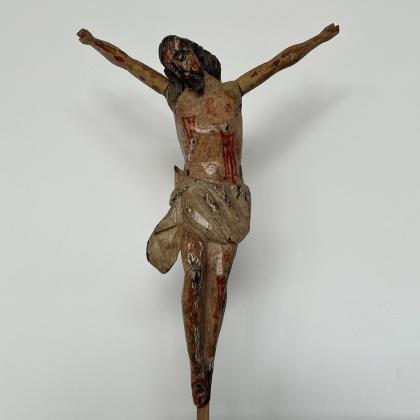
If we wish to truly understand the meaning of Easter, we have to open the Gospel of John the Apostle, at the pages where he described what happened after the Jewish leaders had brought Jesus to the Palace of Pontius Pilate, the Roman Governer of the Province of Judaea. When Pilate had come out, he asked them: “What charges are you bringing against this man?” Whereupon they answered: “If he were not a criminal, we would not have handed him over to you.” Pilate then said: “Take him yourselves and judge him by your own law.” “But we have no right to execute anyone,” they objected. [i] Pilate then decided to take up the case, but after having interrogated Jesus several times, he still found no basis for charging Jesus with any criminal offense. So he handed Him over to the chief priests and officers who had brought Jesus with the words: “You take Him and crucify Him.” To which they answered “we have a law … and according to that law He must die, because He declared Himself to be the Son of God.” Whereupon Pilate “tried to release Him, but the Jews kept shouting, ‘If you release this man, you are no friend of Caesar. Anyone who declares himself a king is defying Caesar’.” When Pilate heard these words, he brought Jesus out, sat on the judgment seat and said to the Jews, “Here is your King!” At this, they shouted, “Away with Him! Away with Him! Crucify Him!” Just to be sure, Pilate asked the High Priests again “Shall I crucify your King?”. Whereupon they replied “We have no king but Caesar.” [ii]
The Kingdoms
During their encounters “in chambers”, Pilate had specifically asked Jesus whether He considered Himself to be the King of the Jews. On this question Jesus had answered: “My kingdom is not of this world. If it were, my servants would fight to prevent my arrest by the Jewish leaders. But now my kingdom is from another place.” With these words, Jesus tried to explain the essential difference between His Kingdom and the kingdoms of the world. When Pilate then said, “So, you’re a king then”, Jesus told Pilate that it was up to him to determine whether He was a king, and, if so, of which kind of kingdom. When Pilate then asked Jesus what reasons could possibly exist for the Pharisees’ request that Jesus be put on trial, Jesus answered: “To this end was I born, and for this end came I into the world, that I should bear witness unto the truth.”
Understanding the Drama of Jesus Christ
In his book The Mark, the esteemed Scottish psychologist, writer and teacher Maurice Nicoll (1884 – 1953) wrote that “the problem of esoteric teaching is to connect a higher level of understanding with a lower level.” According to Nicoll, the supreme example of an esoteric teacher is Jesus Christ, “who was born of a human mother and yet was the Son of God.” … “We can understand nothing of the drama of Jesus Christ unless we understand that he was in a way two things – the Son of Man and the Son of God. This means that he was in contact with a lower level and yet in some way in contact with a higher level. […] Christ came as a mediator between the higher and the lower level. His task was, as simply a human being exposed to every temptation, to overcome everything belonging to the lower level, that is, the human level, and to unite the human level with the divine level. God came down to earth as a human being but as such was unable to use the divine.” [iii]
Man raising himself up
“But you can see,” so continues Nicoll, “that if a man were endowed with powers of a higher level, of the level of Heaven as it is called in the Gospels, and having these powers, or rather, being able to use these powers on earth, he would not make an example of a human being raising himself up through inner battles, inner doubts and human temptations. […] Now if we realize that the task of Christ was to connect the human with the divine, the Son of Man with the Son of God and for this reason he had to suffer everything that a human being must suffer in climbing the ladder of inner development, we can understand the central meaning of the Gospels much better.” Indeed, Jesus Christ set the supreme living example of connecting the lower with the higher level of understanding, not to prove to Himself that He was able to do it, but to give us a demonstration of what it is that we can and may accomplish when we, as Sons of Man, strive to raise ourselves upwards to the level of the Son of God.
I am coming towards You
In the words of John the Apostle, in the hours before He was apprehended to be led before Pontius Pilate, Jesus had “lifted up His eyes to heaven”, and said, “Father, the hour has come; glorify Your Son, that the Son may glorify You, as You gave to Him authority over all flesh, so that all whom You have given to Him, He may give to them eternal life. Now this is eternal life, that they may know You, the only true God, and Jesus Christ, whom You sent. I glorified You on the earth, having completed the work that You have given to Me that I should do. And now, glorify Me—You, Father, with Yourself—with the glory that I had with You before the world existed.” … “But now I am coming towards You, and I speak these things in the world, so that they may have My joy fulfilled within them.” [iv] [v]
“I in them and You in Me”
Christ then described the “work” he had completed on earth as follows: “I have given them the glory You gave Me, so that they may be one as We are one — I in them and You in Me —that they may be perfectly united, so that the world may know that You sent Me and have loved them just as You have loved Me. Father, I want those You have given Me to be with Me where I am, that they may see the glory You gave Me because You loved Me before the foundation of the world. Righteous Father, although the world has not known You, I know You, and they know that You sent Me. And I have made Your name known to them and will continue to make it known, so that the love You have for Me may be in them, and I in them.” [vi]
“I am” … Infinite Beingness
With these words, Christ confirmed that He considered Man in potentia capable of becoming aware of himself as the spiritual being who is conscious of the fact that he fits the image and likeness of his Creator. And so it is that God closes the circle ‒ the lemniscate ‒ of infinite beingness in Man by endowing him with the ability to close, on his own determinism, the circle of beingness in God and be with Christ where He is and where His name is the name of God: “I am“.
+ + + + + + + + +
[i] Gospel of John 18 verses 28 – 31.
[ii] Gospel of John 19 verses 6 – 16.
[iii] The Mark; Maurice Nicoll; Watkins Publishing, Somerset, England; First published 1954.
[iv] Gospel of John 17 verses 1 – 5.
[v] John 17 verse 13
[vi] Gospel John 17 verses 22 – 24.