On the 4th of July, Americans celebrate the 250th anniversary of the Declaration in which Britain’s thirteen American colonies declared “in Congress” that “these United Colonies are, and of Right ought to be Free and Independent States; that they are Absolved from all Allegiance to the British Crown, and that all political connection between them and the State of Great Britain, is and ought to be totally dissolved; and that as Free and Independent States, they have full Power to levy War, conclude Peace, contract Alliances, establish Commerce, and to do all other Acts and Things which Independent States may of right do.”
The guns of Fort Orange
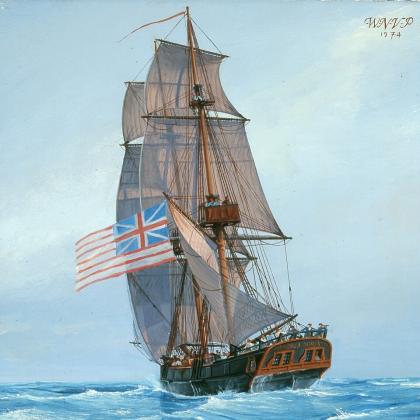
Only a handful of Americans will be aware of the fact that in Novermber of that same year the First Salute given in support of the brand-new American States’ independence was given by the Dutch Governor of the Caribbean island St. Eustatius. In her book, The First Salute, American historian Barbara Tuchman (1912 – 1989) described how “white puffs of gun smoke over a turquoise sea followed by the boom of cannon rose from an unassuming fort on the diminutive Dutch island of St Eustatius in the West Indies on November 16, 1776. The guns of Fort Orange on St. Eustatius were returning the ritual salute on entering a foreign port of an American vessel, the Andrew Doria, as she came up the roadstead, flying at her mast the red-and-white-striped flag of the Continental Congress. In its responding salute the small voice of St. Eustatius was the first officially to greet the largest event of the century ‒ the entry into the society of nations of a new Atlantic state destined to change the direction of history. […] The salute to the Andrew Doria, ordered on his own initiative by the Governor of St. Eustatius, Johannes de Graaff, was the first recognition following the rebel colonies’ Declaration of Independence, of the American flag and American nationhood by an official of a foreign state.”
The Act of Abjuration
A fraction of that small handful of Americans will be aware of the fact that what Tuchman described as the “small voice of St. Eustatius”, was in fact the voice of the powerful Dutch Republic whose founding document may be regarded as the world’s very first Declaration of Independence. It was on the 26th of July 1581, that the States General of Spain’s United Provinces of the Low Countries declared their independence of the Spanish Crown, on practically the same grounds as those laid down almost two centuries later in the American Declaration of Independence. In their Act of Abjuration, which bears the title “Plakkaat van Verlatinghe”, the Dutch States General declared: “As is known to all, a country’s Monarch is appointed by God to be ruler of his subjects, to defend them from injustice, oppression and violence as the shepherd his sheep. The subjects were not created by God for the benefit of the Monarch, to obey everything that he commands, divine or un-divine, right or wrong, to be submissive and serve as slaves; but rather, the Monarch is created by God for the sake of the subjects, without whom he could not reign, and he is there to govern them with right and reason, to love and support them as a father his children or a shepherd his flock, and even at the hazard of [his] life to defend and preserve them.”
Taking leave of a Tyrant
“And when he does not do this,” so continues the Act, “but instead of protecting his subjects, seeks to oppress them and make them suffer, to infringe their ancient freedom, customs and privileges, and to dictate them and use them as slaves, then he can no longer be considered to be a Monarch, but a tyrant. And for this, his subjects must, of right and reason, after deliberation in the States General, no longer acknowledge him as Monarch and renounce him, and instead of him choose someone else for their protection, without them having committed something wrong.” After having enumerated a long series of complaints and accounts of the failed attempts to settle their differences with the Spanish King and reach an amicable agreement, the signatories to the Act then concluded: “[…], wherefore, having no hope of any means of reconciliation and lacking all other remedies and succor, we have, in accordance with the law of nature, in order to protect and maintain our and other countrymen’s rights, privileges, old customs and freedoms of our fatherland, of the life and honour of our housewives, children and offspring, so that they will not fall into slavery of the Spaniards, been constrained by right to take leave of the King of Spain and have been forced to pursue other means, which we found most suitable for the securement and preservation of our aforementioned rights, privileges and freedoms.”
The self-evident truths
The Dutch not only knew what it meant to declare independence, but also what it meant to fight for it. Still, their Salute to the independent American States was not just meant to welcome them as equal in having “full Power to levy War, conclude Peace, contract Alliances, establish Commerce, and to do all other Acts and Things which Independent States may of right do.” The deeper motive for their Salute is to be found in the fact that, in those days, the Americans, like the Dutch, held “these truths to be self-evident, that all men are created equal, that they are endowed by their Creator with certain unalienable Rights, that among these are Life, Liberty and the pursuit of Happiness.–That to secure these rights, Governments are instituted among Men, deriving their just powers from the consent of the governed, –That whenever any Form of Government becomes destructive of these ends, it is the Right of the People to alter or to abolish it, and to institute new Government, laying its foundation on such principles and organizing its powers in such form, as to them shall seem most likely to effect their Safety and Happiness.”
All peoples …
In January 1776, Thomas Paine wrote in the Introduction to his book Common Sense: “The cause of America is in a great measure the cause of all mankind. Many circumstances hath, and will arise, which are not local, but universal, and through which the principles of all Lovers of Mankind are affected, and in the Event of which, their Affections are interested. The laying a Country desolate with Fire and Sword, declaring War against the natural rights of all Mankind, and extirpating the Defenders thereof from the Face of the Earth, is the Concern of every Man, to whom Nature hath given the Power of feeling; […].” Indeed, when you strive for independence and taking leave of tyrants, you cannot deny others that same right. If you do, you’ll eventually become a tyrant yourself. In light of this universal principle, all peoples have the right to dissolve the political bands which have connected them with another, and to assume among the powers of the earth the separate and equal station to which the Laws of Nature and of Nature’s God entitle them. In accordance with these Laws, and in order to protect and maintain their and other countrymen’s rights, privileges, old customs and freedoms of their fatherland, of the life and honour of our housewives, children and offspring, all peoples have the right to take leave of tyrants and pursue other means, which they find most suitable for the securement and preservation of their aforementioned rights, privileges and freedoms, so that they will not fall into slavery.
+ + + + + + + + +